
Miriam's Story : From 3 AM Spreadsheets to Actually Loving What She Does.

Miriam's videos look effortless. That's the whole point. What her 74,000 subscribers don't see is the 23 support messages a week, the Sunday spreadsheet checks, and the three hours spent debugging webhooks instead of baking bread.
The part nobody shows you
A warm kitchen, good light, her voice explaining why this sourdough method is different from all the other sourdough methods you've seen. That's what her audience gets. What they don't see is what happens after she uploads.
The spreadsheet she opens at 11 PM to figure out who paid this month and who didn't. The 23 DMs from people who can't get into her Discord. The three hours she spent last Tuesday not baking bread — not filming, not writing a recipe — but trying to figure out why her Stripe webhook broke and whether it was her fault or Patreon's or some third tool's that nobody from any of the three companies wanted to take responsibility for.
She got into content creation to teach people how to cook. Somewhere along the way, she accidentally became a customer support agent, a database manager, and a part-time software debugger.
How it started
Miriam started her channel six years ago in Helsinki with a secondhand camera, a windowsill herb garden, and a genuine belief that Finnish home cooking didn't get the attention it deserved. Her first video — a simple tutorial on making proper rye bread — got 340 views. Her mum watched it four times. She counts that as a success.

At 25,000 subscribers, she launched a membership. A Patreon page, three tiers, a Discord server for members, and a Google Sheet to keep track of who was where. That was the beginning of the administrative spiral she didn't see coming.
The 10th support message
Every month, Miriam would spend a Sunday manually cross-referencing her Patreon list against her Discord roles. Someone would have cancelled without her noticing — still in the server with full access. Someone new would have joined — paid, but not in Discord at all.
"I remember the exact moment. It was a Tuesday evening. I was supposed to be developing a new recipe. Instead I was writing my tenth support reply of the week. Tenth. I hadn't even opened my recipe notebook." — Miriam
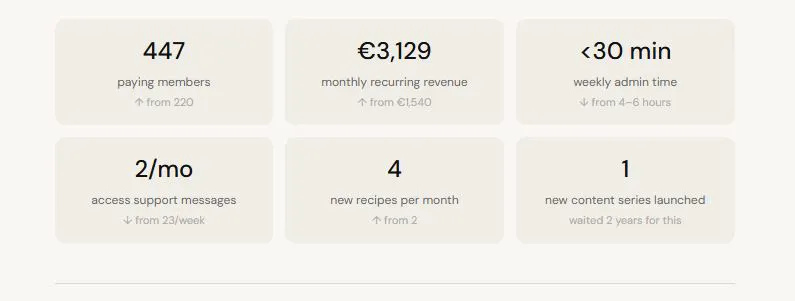
She did the math. At that point, she was spending between four and six hours a week on membership admin. Not strategy. Not content. Not community building. Purely administrative maintenance. Six hours a week. That's 312 hours a year — nearly eight full working weeks.
She wasn't running a membership. She was maintaining one. There's a difference, and it's enormous.
The three problems she couldn't escape
If you zoom out from Miriam's story, her problems weren't unique to her. They're universal to anyone running a paid membership at any meaningful scale.
- Problem 01 - Access control is a full-time job you never agreed to.
People who pay via one method but signed up via another. People who upgrade tiers and don't get new access. People who cancel but stay in Discord for three months. Each edge case requires a human — usually you — to resolve it manually. Multiply by 200 members and you're doing database administration instead of creating.
- Problem 02 - The revenue you can see is not the revenue that's possible.
Miriam knew her membership revenue. She checked it constantly. What she didn't have was clarity on what it could be — the gap between her current conversion rate and a realistic one, how many members were on the cheapest tier who might upgrade. Without that visibility, she was flying blind every single month.
- Problem 03- The tools don't talk to each other — and that's your problem.
Stripe for payments. Patreon for the membership layer. Discord for community. A Google Sheet to track everything. Each tool does its job. None of them coordinate automatically. The person who coordinates them is you. And when something breaks, you're the one who finds out — usually because an unhappy member tells you.
The 3 AM moment
It was a Thursday in October. Miriam had finished editing a video she was genuinely proud of — long-form, two months in the making. She finished at 1:30 AM. Opened her email before bed, the way you're not supposed to.
Eleven new messages. Seven from members. Three were variations of "I joined last week, I still can't get into the Discord." One was someone asking whether their membership had processed because they'd been charged but couldn't access the recipe archive.
"I thought about quitting the membership entirely. Not the channel — I love the channel. But the membership was supposed to add income without adding too much work, and instead it had become this enormous source of stress." — Miriam
Finding FrontRows
She'd seen FrontRows mentioned in a creator forum. Not as an advertisement — just someone asking if anyone had tried it, and a few people saying yes, it had fixed exactly the access control nightmare she was describing.
She signed up on a Friday afternoon. She expected a weekend of setup. She expected it to be complicated. She'd been burned before by tools that promised simplicity and delivered configuration hell.
It took her two hours.
Not two hours of struggling. Two hours of actual setup — connecting her existing tools, defining her membership tiers, telling FrontRows: "When someone pays for this tier, give them this access. When they cancel, remove it. When they upgrade, adjust accordingly."
That was it.
"The first Monday after I set it up, I opened my email expecting the usual. I had two member messages. One was someone saying thank you for the new recipe. One was asking about an ingredient substitution. No access problems. No membership confusion. No one saying they'd paid but couldn't get in."— Miriam
What actually changed
Before FrontRows: four to six hours of membership admin every week. In the first month after setup: under thirty minutes. Not because the membership got smaller. Because the process became automatic.
When someone subscribes to her €7/month base tier, they're automatically added to the right Discord channels. When someone upgrades, their access updates without Miriam doing anything. When someone cancels, they're removed cleanly. No spreadsheet check. No manual membership role adjustment. No support ticket chain.
The 23 weekly DMs from people who couldn't access their membership? Now averaging about two per month.
The promotion she'd been postponing for eight months
Three weeks after setting up FrontRows, she made a YouTube video specifically about her membership. Not a hard sell — just an honest explanation of what members get and why she started it.
In the 72 hours after that video went live, 94 new members joined.
Before FrontRows, that would have meant 94 separate access issues to potentially troubleshoot. Instead, every single one of those 94 people was automatically given the correct access. Miriam's inbox stayed quiet. Her Discord had a wave of new people — the good kind, asking "what should I try first?" — and she could engage as a creator instead of scrambling to fix technical problems.
Her membership went from 220 to 318 in one week. Monthly recurring revenue jumped from €1,540 to €2,226.
What she does with the time now

"I developed four new recipes in November," Miriam says. "I would normally do maybe two, sometimes three. Four felt almost luxurious. The cardamom bun recipe I'd been putting off for months? That was one of them. It's now my most-saved recipe of the year."
She started a new content series on Finnish food history that had been on her ideas list for two years. "I kept saying I'd do it when things calmed down. Things didn't calm down. They got calmer when the admin got handled."
She also stopped feeling guilty about her members. "I hadn't quite realised how much mental weight I was carrying around — this constant low-level guilt about people who had paid and weren't getting what they'd paid for. Once the access started working automatically, that guilt just... lifted."
The numbers tell the story
A thought for you
If you've read this far, you probably recognise something in Miriam's story.
- Maybe you're at 180 members and spending every Sunday doing manual Discord checks.
- Maybe you've got 60,000 followers and you've been meaning to start a paid membership for a year and a half.
- Maybe you've got a membership but you know you're leaving money on the table because you don't have real visibility into your tiers.
The common thread isn't the size of your audience or the number of your members. It's the gap between the creator you could be and the admin overhead that's in the way.
Miriam didn't change her content. She removed a problem that was eating her time and replaced it with a system that handled itself. Then she got to do what she'd always been good at.
That's the whole story. And it can be yours too.